
Continuous Casting Simulation
Overview
This project models the cooling and solidification of molten metal during a continuous casting process. As the metal flows downward through a cooled mold, it transitions from liquid to solid due to heat loss.
Using COMSOL, I simulated:
-
Heat transfer in a moving material (convection + conduction)
-
Phase change using the apparent heat capacity method
-
The formation of the solidification front

What I Learned
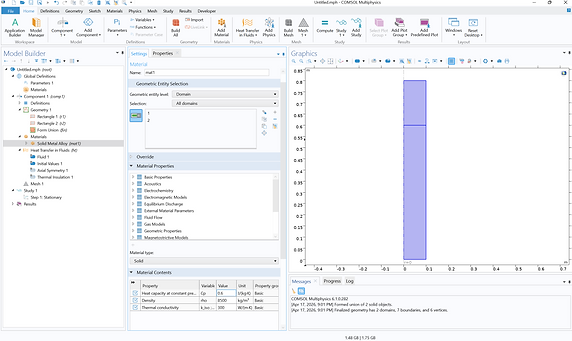
One of the biggest challenges in this simulation is that solidification is highly nonlinear and difficult to solve numerically. To address this, I used a continuation approach:
-
Start with a smooth transition (large ΔT) → easy to solve
-
Gradually reduce ΔT → sharper, more realistic solidification front
-
Apply adaptive mesh refinement to capture the transition region accurately
This approach allowed me to balance solver stability with physical accuracy.
Surface Phase Indicator

This plot shows where the metal is liquid vs solid during the casting process. Red indicates fully liquid material, blue indicates solid, and the transition region represents the solidification front as the outer surface cools faster than the core.
Liquid Fraction vs Radius

This graph shows how the material transitions from liquid to solid across the radius. As the transition range (ΔT) decreases, the curve becomes steeper, indicating a sharper and more physically accurate solidification front.